
Expansion joints in and around swimming pools operate in an unusually demanding environment. They need to accommodate movement between concrete sections while helping maintain a seal under exposure to water, chemicals, sunlight, temperature changes, and regular traffic. Depending on joint location, a sealant may also be subjected to prolonged water exposure or immersion.
These conditions make sealant selection more complex than choosing a material that remains flexible. Product selection should account for anticipated movement, water exposure, chemical contact, substrate condition, joint geometry, application orientation, and cure requirements.
Polysulfide sealants have a long history in demanding joint applications because appropriately formulated products can combine elastomeric movement with resistance to water and various chemicals. These characteristics may make certain polysulfide sealants suitable for expansion joints around pools and other water-containing structures when the specific product is selected, detailed, and installed for the anticipated conditions.
But what exactly is a polysulfide sealant, and which characteristics may support its use in these demanding environments?
WHAT IS A POLYSULFIDE JOINT SEALANT?
Polysulfide sealants are elastomeric sealants based on liquid polysulfide polymers containing sulfur within the polymer backbone. Unlike rigid joint fillers, an elastomeric sealant is designed to deform as the joint changes dimension. When properly formulated, installed, and cured, a polysulfide sealant creates a flexible material that can elongate and compress as adjacent substrates move.
Many polysulfide joint sealants used in demanding construction applications are supplied as two-component systems. Mixing the components in the prescribed proportions initiates the curing reaction that converts the application-ready material into a cured elastomer.
This curing reaction distinguishes a two-component elastomeric sealant from a material that merely fills the joint opening.
The finished joint is not intended simply to fill an opening. It is intended to create a flexible seal between two surfaces while allowing those surfaces to move relative to one another. This is particularly valuable in concrete construction because joints are deliberately incorporated into structures to accommodate movement rather than forcing that movement to occur randomly through cracking.
WHY POOL DECK JOINTS ARE PARTICULARLY DEMANDING
Concrete may appear relatively static after it has hardened, but it continues to experience dimensional changes throughout its service life.
Movement can result from several mechanisms, including:
- Thermal expansion and contraction
- Drying shrinkage
- Moisture-related dimensional changes
- Structural movement
- Differential movement between adjoining materials
- Settlement or other substrate movement
Pool decks add another layer of complexity because the concrete exists immediately adjacent to a structure designed to contain water.
A joint near a swimming pool can therefore encounter several stressors simultaneously: movement, moisture, ultraviolet exposure, chlorinated water, cleaning chemicals, pedestrian traffic, and temperature fluctuations.
In some joint locations, water exposure is intermittent. In others, the sealant may be continuously exposed or submerged. A material that performs well in an ordinary exterior concrete joint is not automatically appropriate for these conditions.
WHY FLEXIBILITY MATTERS IN AN EXPANSION JOINT
Consider an expansion joint separating two concrete slabs.
When temperatures rise, the concrete expands and the joint may become narrower. When temperatures fall, the concrete contracts and the joint may become wider. The sealant must respond to both conditions.
As the joint opens, the sealant is placed in tension and must elongate while maintaining adhesion to both joint faces. As the joint closes, the material is compressed and must deform without being forced out of the joint or losing its ability to recover. These expansion-and-contraction cycles may recur throughout the service life of the installation.
A sealant that is too rigid can place excessive stress at the bond line. A material that loses elasticity over time may eventually crack, tear, or separate from the joint wall.
Polysulfide chemistry has been used in these applications because appropriately formulated products are intended to retain elastomeric properties after curing, enabling the material to accommodate recurring movement rather than function as a rigid filler. Actual performance depends on the selected product, joint design, installation, cure, and service conditions.
WATER RESISTANCE IS MORE THAN A SURFACE PROPERTY
For pool-related construction, resistance to water is fundamental.
Water can challenge a joint sealant in several ways. It may remain on the surface, repeatedly wet and dry the material, migrate along interfaces, or remain in contact with the sealant for extended periods.
Long-term water exposure can adversely affect some polymer systems by changing physical properties or weakening adhesion.
Polysulfide polymers have historically been used where resistance to water and moisture is required. Suitability for frequent water exposure or continuous immersion, however, depends on the specific product, substrate, joint design, installation procedures, cure conditions, and the manufacturer’s stated limitations.
This is an important distinction when evaluating pool joint sealants.
A product described as suitable for exterior joints is not necessarily rated for prolonged immersion. Likewise, water resistance and immersion suitability should not be assumed to mean the same thing. The product’s technical data should specifically address the intended exposure.
WATER RESISTANCE VS. CONTINUOUS IMMERSION
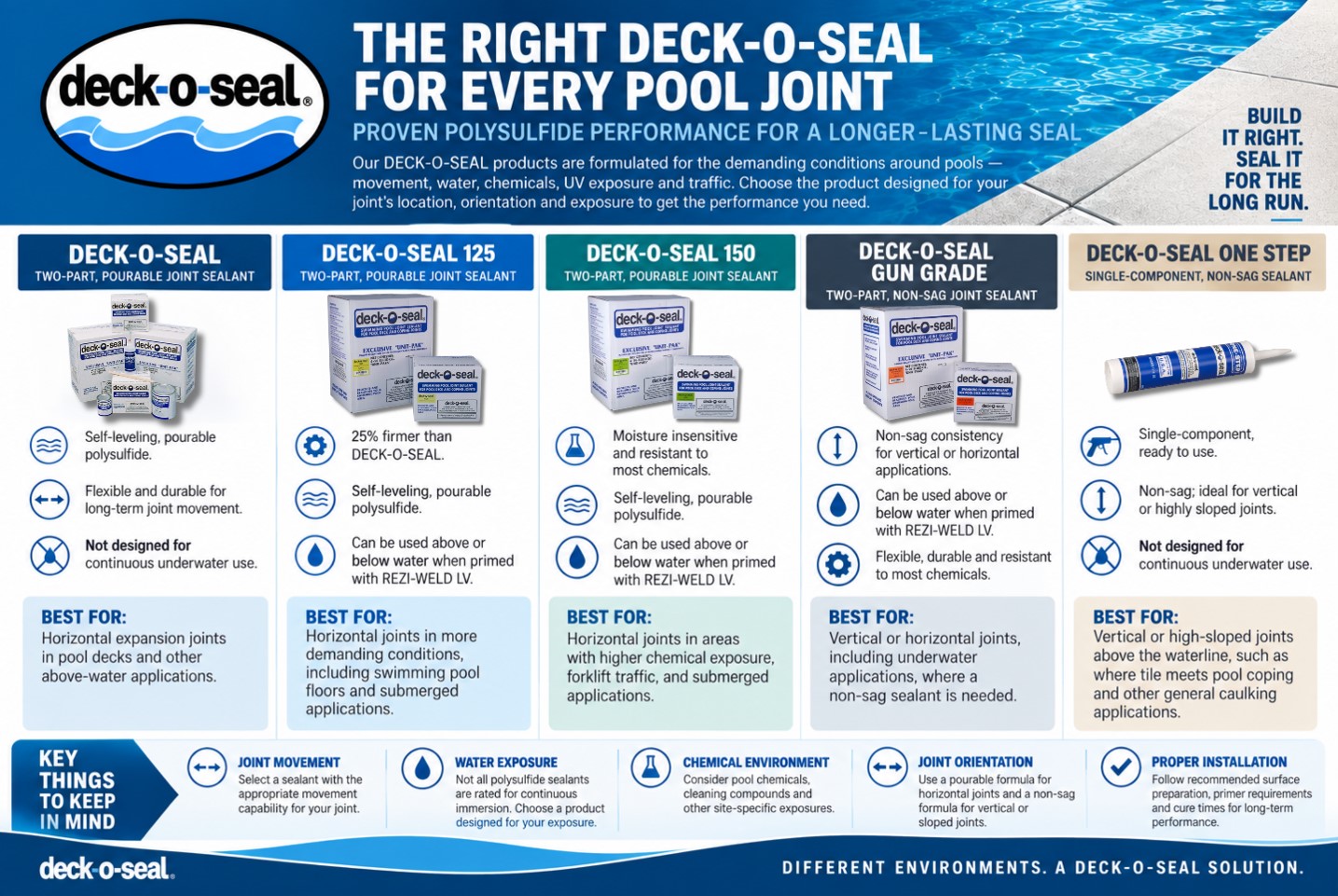
Not every polysulfide sealant is suitable for continuous underwater service. Although polysulfide polymers may provide resistance to water, immersion capability depends on the complete formulation, curing system, adhesion characteristics, primer requirements, and installation conditions. These factors affect whether the cured sealant and its bond to the substrate can maintain their properties during prolonged water exposure. A polysulfide sealant may therefore perform well during rain, splash, washdown, and repeated wet/dry cycles without being designed for continuous immersion.
For joints that will remain below the waterline, the specific sealant must be identified by its manufacturer as suitable for continuous immersion under the anticipated service conditions. Required substrate preparation, primers, application conditions, and minimum cure time before water exposure must be verified in the current product data sheet and other applicable written manufacturer instructions. Water resistance and immersion suitability are not interchangeable.
CHEMICAL RESISTANCE IN THE POOL ENVIRONMENT
Pool water is not simply potable water.
Maintaining water quality requires chemical treatment, and joint materials around the pool may be exposed to chlorinated water, cleaning compounds, and other substances used during routine operation and maintenance.
Chemical exposure can alter certain elastomers by causing swelling, softening, hardening, loss of adhesion, or deterioration of mechanical properties. Certain polysulfide sealants have historically been used where both flexibility and resistance to specified chemicals are required; actual resistance depends on the complete formulation and the conditions of exposure.
However, chemical resistance should always be evaluated against the actual exposure. Concentration, temperature, duration of contact, frequency of exposure, and chemical composition can all affect performance. A sealant’s compatibility with anticipated pool-treatment and cleaning chemicals should therefore be verified rather than assumed from a general chemical-resistance claim.
THE IMPORTANCE OF ADHESION
A sealant can possess excellent physical properties and still fail if it does not remain bonded to the joint walls. This is known as adhesive failure.
Adhesive failure occurs when the sealant separates from the substrate. Cohesive failure, by contrast, occurs when the sealant itself tears while remaining bonded to the substrate. Both failure modes can compromise the joint.
Concrete joint surfaces must therefore be properly prepared before sealant installation. Depending on the condition of the concrete, preparation may involve removing laitance, curing compounds, coatings, dirt, dust, oils, previous sealants, and other contaminants that could interfere with adhesion.
The joint surfaces also need to satisfy the sealant manufacturer’s current written requirements concerning moisture condition and primer use. Primer requirements should be verified rather than treated as optional because they may vary with the substrate, product, and anticipated exposure. Where required, the specified primer is part of the installation system intended to support adhesion.
JOINT GEOMETRY IS PART OF THE SEALANT PERFORMANCE
Sealant selection receives considerable attention, but joint geometry can be just as important as sealant chemistry. An elastomeric sealant should be configured so that it can deform predictably as the joint moves. This generally means controlling the depth of the sealant and preventing adhesion to the bottom of the joint.
A properly installed backer rod can serve several functions. It controls sealant depth, supports the uncured sealant during installation, helps establish the desired profile, and acts as a bond breaker at the bottom of the joint. The objective is generally two-sided adhesion: the sealant bonds to the two opposing joint faces but not to the bottom.
Why? If the sealant adheres to three surfaces, movement creates complex stresses within the sealant bead. This condition, commonly referred to as three-sided adhesion, restricts the sealant’s ability to elongate and can concentrate stresses in ways that promote premature failure.
With appropriate joint geometry, the sealant can stretch and compress more uniformly. The required width-to-depth relationship, backing material, and bond-breaker configuration must be established for the selected product and project conditions in accordance with the current product data sheet, project specifications, and applicable design requirements rather than by filling the entire joint cavity with sealant.
MOVEMENT CAPABILITY MUST MATCH THE JOINT
Not every elastomeric sealant can accommodate the same amount of movement. Sealants are commonly classified according to their ability to accommodate a percentage of movement relative to the original joint width.
For example, a joint that is 1/2 inch wide at installation will not necessarily remain 1/2 inch wide throughout the year. Its actual service width depends on temperature, concrete movement, structural conditions, and the point in the movement cycle when the sealant was installed. This is why movement capability should be considered during design and material selection.
The question is not simply: “Is this sealant flexible?”
A more useful question is: “Can this sealant accommodate the anticipated movement of this particular joint while maintaining adhesion and integrity under the expected exposure conditions?”
That distinction becomes increasingly important as joint dimensions and movement demands increase.
SEALANT HARDENESS IS A BALANCE
Pool deck sealants must balance movement accommodation with sufficient durability for their environment. A very soft elastomer may deform easily, but horizontal joints can also experience foot traffic, maintenance activity, cleaning, and localized mechanical contact. Conversely, making a sealant excessively hard can reduce its ability to deform with joint movement.
Successful joint-sealant formulations balance these properties rather than maximizing one at the expense of another.
This is another reason chemistry and formulation should be considered together. The polymer family provides the foundation for performance, but the finished sealant’s hardness, elongation, adhesion, recovery, movement capability, and exposure resistance determine whether it is appropriate for a particular joint.
HORIZONTAL VERSUS VERTICAL APPLICATIONS
Application characteristics also matter. Horizontal deck joints are often sealed using a self-leveling or pourable formulation. The material flows into the prepared joint and develops a relatively smooth surface. Vertical joints require a material with different rheology. A non-sag or gun-grade formulation must remain in position rather than flowing out of the joint before curing.
The underlying polysulfide chemistry may be similar, but the formulation is adjusted for the intended orientation and application method. Using the correct grade is therefore part of proper system selection.
CURE CONDITIONS MATTER
With a two-component polysulfide sealant, correct proportioning and thorough mixing are essential because curing depends on the reaction between the components. Incomplete mixing can create areas that remain soft, tacky, or inadequately cured. Temperature can affect working time and cure rate, but the effect and acceptable application range depend on the specific formulation. Use the temperatures, mixing instructions, working times, and cure requirements stated in the current product literature.
These factors become particularly important around swimming pools because returning the area to service too early can expose an incompletely cured sealant to water, traffic, or chemicals before it has developed its intended properties.
Current written manufacturer requirements for mixing, application temperature, curing time, and immersion exposure should therefore be treated as functional parts of the installation—not merely procedural recommendations.
WHY POLYSULFIDE TECHNOLOGY FITS POOL EXPANSION JOINTS
No single property makes polysulfide technology appropriate for pool-related joints. Its value comes from the combination of characteristics required by the environment.
Depending on the specific formulation and stated product limitations, a polysulfide sealant may offer characteristics relevant to demanding pool-joint applications:
- Elastomeric movement capability. The cured material can deform as concrete joints expand and contract.
- Resistance to water. Certain polysulfide sealants are intended for frequent or prolonged moisture exposure; suitability for continuous immersion must be confirmed for the specific product and service conditions.
- Chemical resistance. Resistance to specified chemicals depends on the complete sealant formulation and the concentration, temperature, duration, and frequency of exposure.
- Durable adhesion. When the substrate is correctly prepared and applicable primer and installation requirements are followed, the sealant is intended to develop adhesion to concrete and other substrates identified as compatible in the current product literature.
- Long-term flexibility. Maintaining elastomeric behavior is critical when a joint will continue moving throughout the life of the structure.
These characteristics address several of the primary stresses present around swimming pools at the same time.
A SEALANT IS ONLY ONE PART OF A SUCCESSFUL JOINT
Even a high-performance polysulfide sealant cannot compensate for poor joint design or installation. Long-term performance depends on the entire joint system: joint width, sealant depth, surface preparation, backer rod selection, primer requirements, mixing, application, curing conditions, anticipated movement, and environmental exposure.
Existing joints should also be evaluated before resealing. Installing new material over deteriorated sealant, contaminated joint faces, or unsound concrete can transfer existing problems directly into the new installation. The goal should be to create a properly configured elastomeric joint, not simply to cover the visible opening.
UNDERSTANDING THE TECHNOLOGY BEHIND THE JOINT
Expansion joints around pools occupy a relatively small portion of the finished structure, but their performance can have significant consequences. They exist at locations where movement is expected, water is abundant, and environmental exposure can be severe. That combination places substantial demands on the sealant.
Polysulfide joint sealants may address these demands through formulations intended for flexible sealing applications involving moisture and specified chemical exposures. When an appropriate product is selected and installed in a properly designed joint in accordance with current manufacturer requirements, the sealant is intended to accommodate recurring movement and help limit water intrusion. Successful pool deck joint sealing depends on the combined effects of sealant selection, joint design, exposure conditions, substrate condition, and installation practices.
Understanding polysulfide technology supports a more deliberate selection process. Long-term joint performance depends on using a product intended for the anticipated movement and exposure and following the current requirements for joint design, preparation, application, and cure.
*This article provides general educational information about polysulfide sealant technology and is not a project specification, installation instruction, warranty, or substitute for evaluation by the project designer or other qualified professional. Product suitability, substrate preparation, joint design, application conditions, cure requirements, chemical compatibility, and immersion exposure must be confirmed using the current product data sheet and written manufacturer guidance for the specific product and project.